
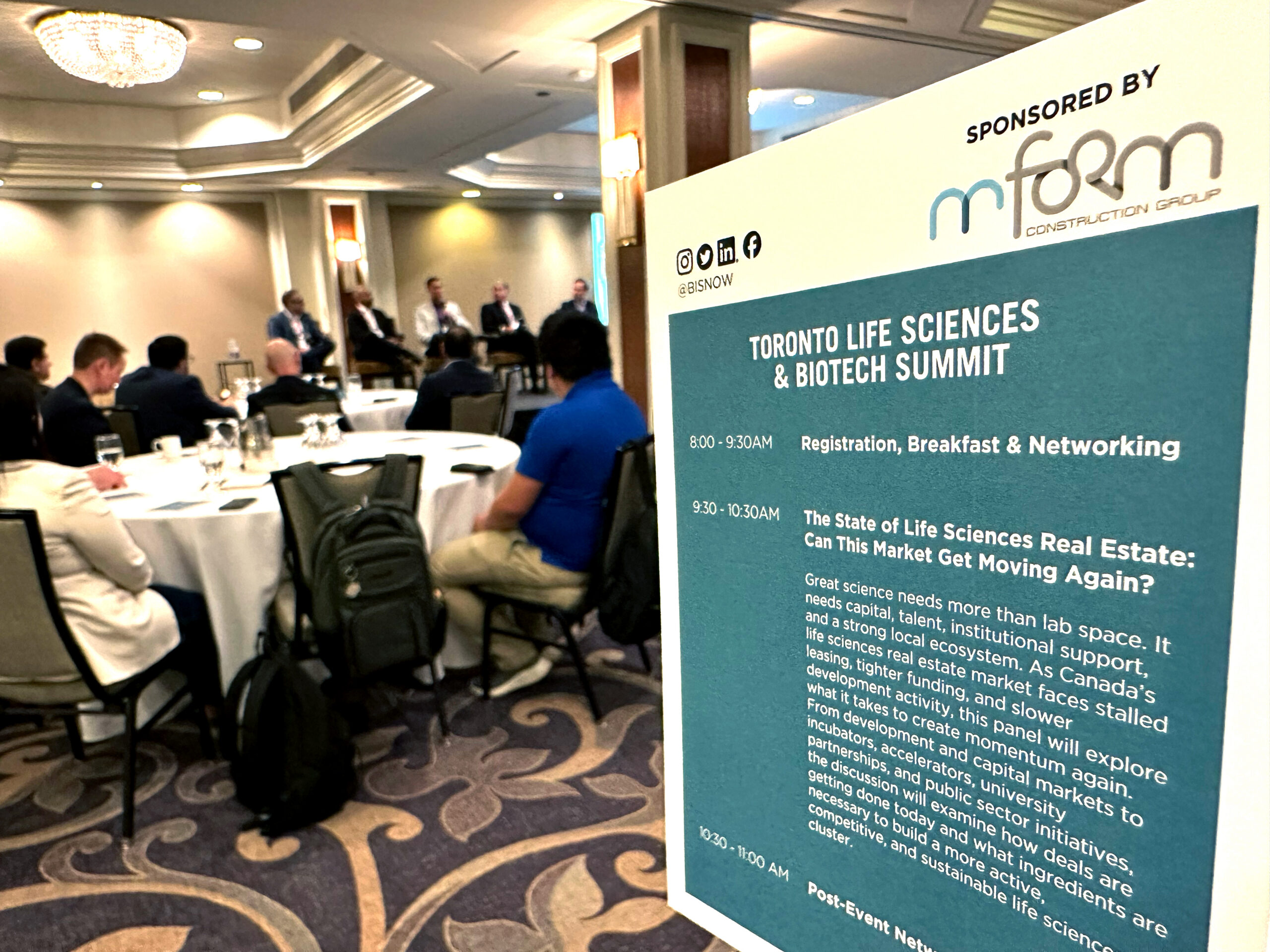
Toronto’s life sciences sector continues to evolve as developers, investors, biotech leaders and public-sector stakeholders work to balance short-term market pressures with long-term growth opportunities.
With leasing activity slowing, funding conditions tightening and tenant demand evolving, Bisnow’s Toronto Life Sciences & Biotech 2026 Summit brought together leaders across life science commercial real estate and the innovation economy to discuss how the sector can sustain long-term growth momentum.
Xtalks was proud to serve as a media partner for the event, which explored the future of life sciences real estate, innovation districts and biotech expansion in Toronto and across Canada.
The summit’s featured panel discussion, The State of Life Sciences Real Estate: Can This Market Get Moving Again?, examined the current realities shaping Canada’s life sciences infrastructure landscape and highlighted why building a successful ecosystem requires more than laboratory space alone.
Building a Competitive Life Sciences Ecosystem in Toronto and Canada
Panelists discussed how access to capital, talent pipelines, institutional partnerships and coordinated innovation infrastructure are increasingly determining which markets are positioned for long-term success.
The speakers also explored how developers, investors, academic institutions and government stakeholders are working together to create more sustainable and competitive environments for biotech growth and commercialization.
 The discussion reflected broader changes occurring across North America’s life sciences real estate market. While demand for purpose-built laboratory infrastructure surged during the pandemic-era biotech boom, the market has since entered a more cautious phase. Venture capital deployment has slowed, early-stage biotech companies are managing tighter funding conditions and developers are reassessing expansion timelines.
Despite these pressures, advances in areas such as precision medicine, oncology, cell and gene therapy and AI-enabled drug discovery continue to drive demand for research infrastructure and specialized innovation ecosystems.
A recurring theme throughout the Summit was the growing importance of cluster development and ecosystem integration. Panelists highlighted that successful life sciences hubs depend not only on physical infrastructure, but also on strong connections between academia, healthcare institutions, government programs, investors and industry partners.
Toronto’s position within Canada’s life sciences ecosystem was also a central focus of discussion. The region benefits from a strong concentration of academic institutions, research hospitals and healthcare networks, alongside increasing investment in biotech and biomanufacturing infrastructure. Institutions such as the University of Toronto, University Health Network (UHN), MaRS Discovery District and other regional innovation organizations continue to support commercialization, translational research and startup growth across the sector.
The Summit also explored how innovation districts are evolving to support talent attraction and retention. Beyond laboratory infrastructure, the speakers discussed the importance of transit access, mixed-use development, collaboration spaces and proximity to academic and healthcare institutions in creating environments that appeal to both companies and highly skilled scientific talent.
As Canada’s life sciences sector continues to mature, the event underscored that future growth will depend on coordinated strategies that connect capital, infrastructure, policy and talent development.
Bisnow’s Toronto Life Sciences & Biotech 2026 Summit highlighted both the challenges and opportunities shaping the next phase of Canada’s innovation economy.
While market conditions remain complex, the discussions made clear that stakeholders across the ecosystem remain focused on building a more resilient, globally competitive and innovation-driven life sciences sector.

Comments
Add a comment